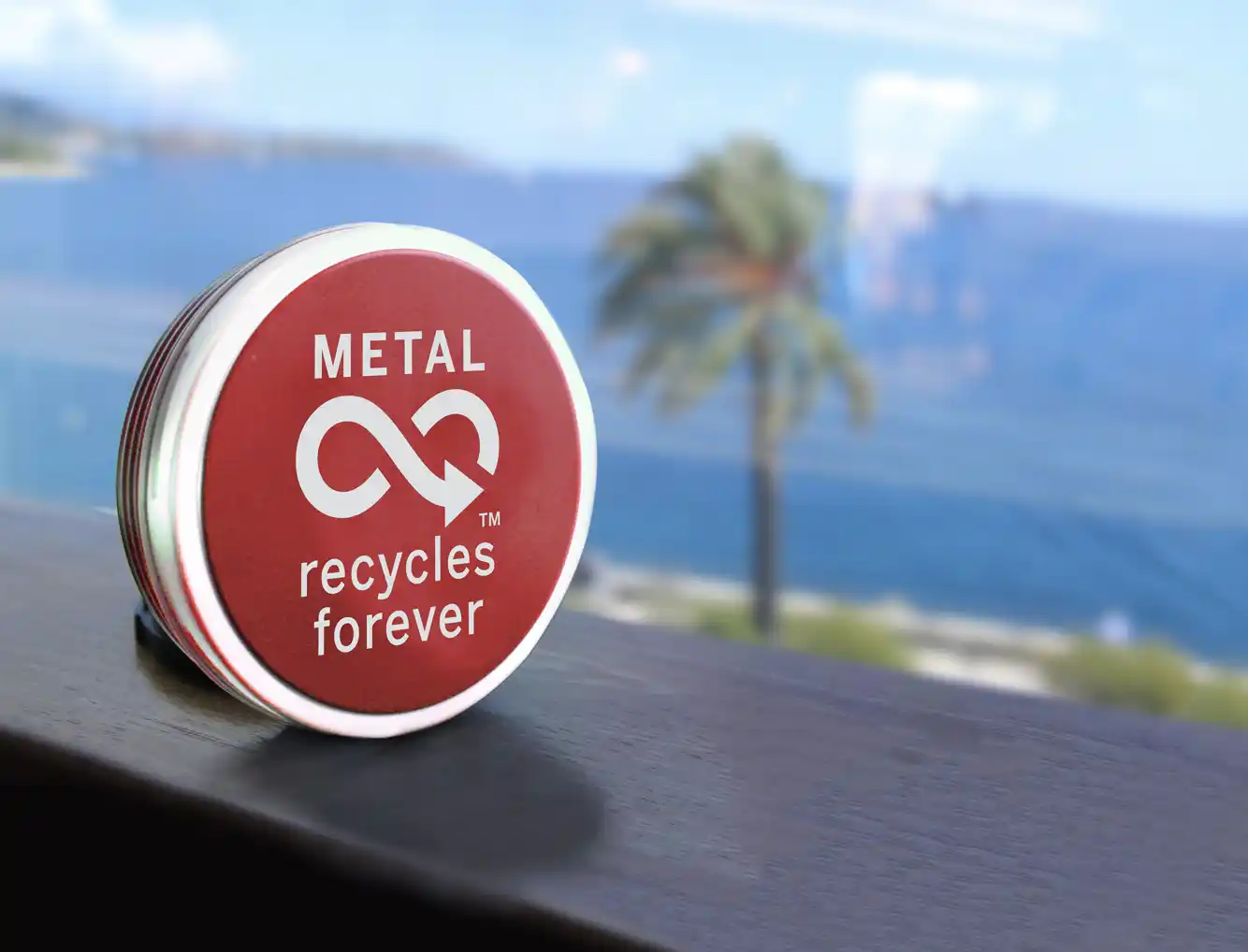
L'opinion publique européenne et les emballages métalliques
L'opinion publique en Europe est de plus en plus favorable aux emballages métalliques. Les gens sont de plus en plus au courant des conséquences négatives liées à l'utilisation de types d'emballage non durables. Ils sont donc de plus en plus enclins à choisir activement d'utiliser des produits qu'ils savent être fabriqués de manière durable, qui peuvent être recyclés et qui sont meilleurs pour l'environnement que des emballages en plastique. Un des facteurs majeurs de cette tendance est l'exposition croissante du public aux informations présentant les métaux recyclables comme une forme d'emballage durable.
Metal Packaging Europe et le logo « Recycles Mark »
Metal Packaging Europe est une organisation qui a pour but d'augmenter l'utilisation des emballages métalliques en Europe, à la fois pour les produits industriels et commerciaux. Pour cela, ils créent des liens entre les fabricants, les fournisseurs, les associations nationales et les consommateurs. Metal Packaging Europe fournit énormément d'informations quant aux avantages de l'utilisation des emballages métalliques et s'implique dans la politique de l'Union Européenne pour créer une législation plus durable. Actuellement, une de leurs préoccupations principales est l'utilisation de leur « Recycles Mark ». Le logo « Recycles Mark » peut être utilisé sur les emballages métalliques respectant les critères de Metal Packaging Europe et signifie que ce produit est recyclable. Les critères de Metal Packaging Europe pour l'utilisation de ce logo sont que le produit soit fabriqué à l'aide de métaux recyclables (fer ou aluminium), que le logo soit utilisé à un endroit défini par Metal Packaging Europe, et qu'il s'agisse d'un design/d'une couleur prédéfinie par Metal Packaging Europe. De plus, Metal Packaging Europe se réserve le droit de retirer le logo de tout produit qu'ils considèrent comme ne répondant pas aux critères [1,2,3]. Vous pouvez trouver plus d'informations sur l'utilisation du logo « Recycles Mark » ici : https://www.metalpackagingeurope.org/recyclesmark.
L'objectif du logo : sensibiliser fabricants et consommateurs
Metal Packaging Europe espère ainsi que ce logo amènera les consommateurs à mieux comprendre le rôle qu'ils ont à jouer en matière de recyclage de produits métalliques. En recyclant les produits métalliques, le matériau brut peut être réutilisé pour créer de nouveaux produits futurs. Le logo communique également sur la valeur intrinsèque du recyclage de métaux grâce aux propriétés permanentes de leurs éléments de base. Le logo donne aux fabricants l'opportunité de démontrer que leur produit a été conçu à l'aide de métaux recyclables et durables, et permet aux consommateurs de prendre une décision informée lors de leurs achats de produits [1,2,3].
Les métaux concernés par le logo
Le logo « Recycles Mark » est actuellement utilisé avec les métaux qui se décomposent en éléments d'aluminium et de fer [3]. Quelques-uns de ces exemples courants sont les alliages de fer-blanc, d'acier et d'aluminium. L'acier et le fer-blanc sont tous deux composés en majeure partie de fer. L'acier est un alliage de fer et de carbone, tandis que le fer-blanc est constitué d'acier avec une couche additionnelle en étain. Les autres composants, souvent du magnésium, du zinc ou du cuivre, offrent différentes propriétés basées sur les exigences du produit [4]. L'aluminium et le fer sont les cibles du logo « Recycles Mark » parce que ce sont les deux métaux les plus couramment utilisés dans les emballages et peuvent facilement être recyclés.
Les bénéfices environnementaux du recyclage des métaux
Le message transmis par Metal Packaging Europe à travers « Recycles Mark » est extrêmement important, car le recyclage permet de réduire drastiquement l'énergie requise par la production d'emballages métalliques.
Le cas de l'aluminium
Recycler et réutiliser de l'aluminium nécessite 95% d'énergie en moins par rapport à l'énergie requise par l'extraction et le traitement de minerai d'aluminium. Une tonne d'aluminium recyclé équivaut à une économie d'énergie de 14 000 kilowattheures, ce qui est suffisant pour alimenter environ 1,5 foyer américain pendant un an. En plus de cette économie d'énergie, 1 tonne d'aluminium recyclé économise également 40 barils de pétrole et 10 verges cube de décharges de déchets [5]. Le pétrole est une ressource non renouvelable qui a de nombreux effets négatifs prouvés sur l'environnement, le plus connu étant l'impact sur les changements climatiques. Les décharges sont de plus en plus remplies et peuvent être nuisibles pour l'écosystème local.
Le cas de l'acier et du fer-blanc
Le recyclage du fer-blanc et de l'acier ne génère pas autant d'économie d'énergie que celui de l'aluminium, mais reste quand même conséquent. Une tonne d'acier ou de fer-blanc recyclés économise 642 kilowattheures, 1,8 barils de pétrole, et 4 verges cube de décharge. A l'échelle globale, l'acier est actuellement recyclé à un taux de 80%, ce qui génère une économie d'énergie suffisante que pour alimenter 18 millions de foyers durant 1 an [5,6,7].
Les avantages pour les fabricants
En plus de ses bienfaits environnementaux, l'utilisation du logo « Recycles Mark » est aussi avantageuse pour les fabricants. Le logo attire les consommateurs et améliore la visibilité du produit. Les consommateurs qui sont déjà sensibles à l'environnement sont attirés par des entreprises qui partagent le même souci. Les consommateurs qui ne sont pas encore sensibilisés aux questions environnementales sont quant à eux exposés aux bienfaits de l'utilisation de récipients en fer-blanc et aluminium recyclables. Sur le long terme, ces consommateurs pourront à leur tour être sensibles à ces questions et achèteront alors des produits respectant ces valeurs. Le logo « Recycles Mark » est une façon pour les entreprises d'atteindre leur public, d'aider l'environnement et d'augmenter leurs ventes.
Conclusion : rapprocher fabricants et consommateurs
Le logo « Recycles Mark » représente une façon de connecter les fabricants et les consommateurs, eux qui sont bien souvent si éloignés. Il agit de façon subtile pour garantir que ces deux acteurs comprennent les bienfaits de l'utilisation du recyclage, pour rappeler aux consommateurs d'acheter des produits en métaux recyclables, pour améliorer les ventes de produits et pour aider les fabricants à atteindre leurs objectifs en matière de rendement énergétique. En rapprochant ces deux parties, l'espoir de voir le métal devenir le choix préféré pour les emballages commerciaux et industriels en Europe est réel.
References
[1] "Metal Packaging Europe gives Europe’s rigid metal packaging industry a unified voice" (retrieved May 2019), by Metal Packaging Europe.
[2]"Recycles Mark Off-Pack Guidelines. Recycles Mark Off-Pack Guidelines" (retrieved May 2019), by Metal Packaging Europe.
[3]"Recycles Mark On-Pack Guidelines, Recycles Forever Mark" (retrieved May 2019), by Metal Packaging Europe.
[4] "Toward a Greener Soda Can - NYTimes.com" (retrieved June 2012), by Matthew L. Wald.
[5]"FAQ: Benefits of Recycling," by Stanford University, California.
[6] "Steel is the World's Most Recycled Material" (accessed April 2019), by the Steel Recycling Institute.
[7] “Component End-of-Life Management: Exploring Opportunities and Related Benefits of Remanufacturing and Functional Recycling,” by Derek Diener and Anne-Marie Tillman.