
Back

Embossing and Debossing: Creating Textured Effects on Metal Packaging

August 17, 2026

[Name]
rectangular metal box

IN A NUTSHELL

  • Embossing produces a raised pattern, while debossing produces a recessed pattern: the same tool is used, but the direction of deformation is reversed.
  • On metal, the relief is created by mechanically cold-forming the sheet metal, without adding any material.
  • The design is engraved into the tool: it cannot be changed afterward, unlike a printed design.
  • The cost is almost entirely fixed, which makes the process cost-neutral at scale and uneconomical for very small volumes.
  • Depth, radii of curvature, and registration tolerances for printing are determined during the design phase, not during production.

Table of Contents

Embossing, debossing, and embossing: three terms for the same principle

Embossing refers to a raised pattern, debossing to an indented pattern, and embossing to the process that produces either one. In printing, the term “folder” is also used to describe the indentation created on paper. On metal, the technical terminology uses “embossing” for the raised pattern and “debossing” for the recessed impression, but the mechanical process is identical in both cases: the material is locally deformed between two complementary dies.

The most common confusion arises in the world of arts and crafts, where “embossing” refers to a technique involving embossing powder that is melted onto paper using a heat gun. This process has nothing in common with industrial embossing. On a steel or aluminum sheet, no additional material is added: the relief is created by cold-forming the substrate itself, and it is an integral part of the part.

A third term is in circulation and adds to the confusion: “repoussé metal.” It refers to a craft activity that involves manually shaping a thin, pliable sheet of aluminum by hand—using a ball-tipped stylus on a foam mat—to create decorative relief patterns. The technique is similar in principle, but the purpose and tolerances are not at all comparable: metal embossing produces a one-of-a-kind piece, while industrial embossing reproduces a strictly identical pattern on tens of thousands of boxes.

How Relief Is Created on a Sheet of Metal

The process relies on a pair of tools: a die with an engraved recess and a punch that fits into that recess. The sheet metal, already decorated and varnished, passes between the two. Under pressure, the metal flows locally and takes on the desired shape, without being cut or pierced. The process is done cold, which preserves the printed design provided that the deformation remains within the material’s elongation limits.

The relief is therefore determined by the tooling, not by a machine setting. Each design requires a dedicated engraving, created from a vector file and approved via a proof before production begins. An embossed design cannot be modified after the fact, unlike a printed design, which means that the entire approval process must take place well in advance of the project.

How Embossing Enhances Metal Packaging

A tactile cue even before reading

Texture is perceived by the hand before being seen by the eye, making it the only design element that engages the senses outside the visual field. A logo embossed on a lid is recognizable both on the shelf and when the package is opened. This tactile dimension is often associated with high-end products, where the experience of opening the package is an integral part of the product itself.

A play of light that printing alone cannot produce

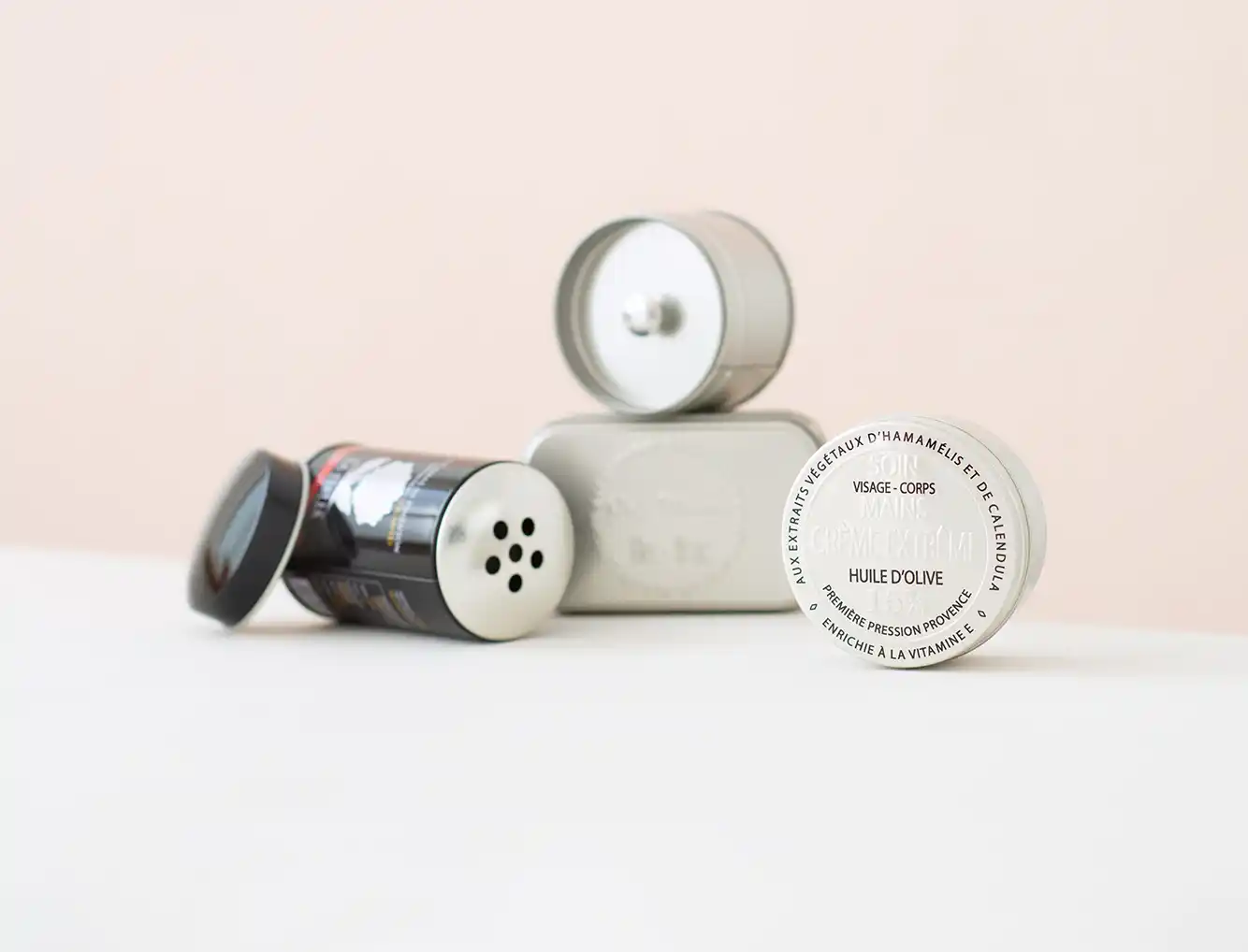
On a metal surface, the relief creates variations in shadow and sheen that change depending on the angle of the light. The reflective metal amplifies this effect, and no printed solid color can reproduce these shifting textures. This explains why embossing is most often reserved for areas with strong symbolic significance: logos, seals, vintage years, and indications of origin.

Apply texture to an entire surface, not just a logo

Embossing isn’t just used to apply a mark—it also adds texture to an entire surface. A guilloché background, a repeating pattern, or a grained finish adds depth to the entire surface without relying on printed decoration, using the interplay of raised and recessed areas to catch the light. This technique is commonly used on box lids, where it creates a sense of depth where a solid color would otherwise appear flat.

A marker that is difficult to replicate

Reproducing a raised design requires specialized equipment, whereas reproducing a printed design requires only a digital file. This technical barrier makes embossing a secondary but genuine brand security measure, just like hot stamping or laser engraving on other substrates. It usefully complements an anti-counterfeiting strategy without serving as its sole pillar.

Constraints to be considered from the design stage

Depth, Radius, and Thickness of the Substrate

The depth of the embossing is limited by the metal’s elongation capacity, which in turn depends on the thickness and grade of the sheet metal. An embossing that is too deep or has edges that are too sharp thins the material, leaves marks on the reverse side, and can cause the varnish to crack. Corners must therefore be rounded with radii of curvature, and fine lines should be avoided in favor of solid shapes, which are better supported by the substrate.

Interaction with the printed background

An embossed pattern added after printing must be registered properly; otherwise, the embossed relief and the printed outline will be visibly misaligned. This registration tolerance dictates the design itself: a contour that must be followed to within a tenth of a millimeter is risky, whereas a standalone or intentionally overhanging embossed relief is more robust. Combining embossing with traditional printing remains quite common, provided that the design incorporates this tolerance from the outset.

Location on the body or on the lid

The lid is the most suitable area, as it offers a flat, unobstructed surface that is visible first. The body of the box is subject to more constraints: the crimping, folding, and gripping areas must remain intact, and any raised areas in the wrong place can interfere with stacking or the seal’s tightness. On round shapes, the curvature of the container adds an additional constraint to tool positioning.

Can your design be embossed?

Depth, radii of curvature, and paint adhesion: these trade-offs are determined by your design file, not in theory. Send us your design, and we’ll tell you what the metal can actually achieve.

Tooling and Production Runs: The True Cost of Molding

The cost of embossing is almost entirely fixed: it depends on the cost of engraving the tool, not on the production time per unit. Once the tool is made, the embossed pattern is produced as part of the manufacturing process, without any significant additional manual work. The result is clear: the process becomes cost-neutral once a certain volume is reached, and becomes uneconomical for very small production runs.

Since the tooling is tied to the design, any change to the design requires a new engraving. This is a strong argument for embossing a permanent element—typically a brand name or a line motif—rather than a seasonal message that is intended to change. Variable elements are meant to remain part of the printed design, which is much more flexible to update from one series to the next.

Which metals can be embossed, and to what extent?

Aluminum is the most malleable metal: its low hardness allows it to be embossed with deep reliefs without requiring significant pressing force. This is also why it is used in arts and crafts, in the form of thin sheets that are shaped using a ball-tipped stylus or the rounded tip of an embossing tool. In packaging, however, this very malleability comes with a trade-off: aluminum deforms easily, so it does not hold up well against sharp edges and struggles to accommodate off-center embossing, which causes the entire piece to warp.

Tinplate, which is stiffer, produces sharper raised designs and is better suited for large textured surfaces. Brass and stainless steel, which are used exclusively for plaques and labels, require much greater pressure but ensure that the relief remains durable. Regardless of the metal, the rule remains the same: the thinner the metal sheet, the easier it is to achieve relief, and the greater the risk of marking the reverse side or warping the piece.

Metal Embossing: More Than Just Packaging

Metal embossing isn’t limited to boxes—it’s also used to produce raised identification plates and labels. It’s found on aluminum, brass, and stainless steel plates, where the raised design serves a dual purpose. First, it enhances the aesthetic appeal of high-end brand labels. Second, it serves a functional purpose for markings designed to last, since embossed text resists abrasion and solvents where surface printing eventually wears off.

The technical process is the same as that used in packaging: the design is engraved into the tool, the material is shaped, and nothing is added. This similarity explains why the same techniques are used in very different fields, and why a search for “metal embossing” yields results ranging from decorative metal sheets to industrial plates and tin cans.

Surface Texture and Food Contact: Key Considerations

The forming process is applied to a sheet that has already been coated with varnish, which raises questions about the integrity of the coating after embossing. A properly selected and cured varnish will conform to the forming process without microcracking, but this capability must be verified for the selected embossing depth, particularly when the embossed area comes into direct contact with the product. For food packaging projects, the embossing is therefore more often applied to the outer surfaces of the packaging.

FAQ

Frequently Asked Questions About Embossing Metal Packaging

What is the difference between metal embossing and metal repoussé?

Metal embossing is a reproducible industrial process, while metal stamping is a manual craft activity. The former requires engraved dies and a press, while the latter requires only a simple embossing tool with a rounded tip and a sheet of flexible aluminum foil, sold in silver or gold at craft stores. Both create raised patterns, but neither the tolerances nor the production volumes are comparable.

What is the difference between embossing and debossing?

Embossing produces a raised pattern, while debossing produces an indented pattern. Both are achieved using the same type of tooling; only the direction of deformation changes. Debossing is often preferred when a raised pattern might rub against other sheets during stacking or transport.

Can embossing be combined with traditional printing?

Yes, and it’s actually the most common combination used on metal packaging. The printing is done on flat sheet metal, and then the embossing is applied while adhering to a registration tolerance that must be factored into the design.

Does the embossing weaken the box?

A properly sized embossing does not affect the container’s mechanical strength and may even increase its rigidity in certain areas. The risk arises with deep or angular embossings, which thin the material and place excessive stress on the coating.

Do you need a specific tool for each pattern?

Yes, the design is engraved into the tool, and there is no way to modify it afterward. That is why approval of the file and then the proof determines the entire production schedule.

Can aluminum be embossed like tinplate?

Both materials can be embossed, but aluminum deforms more easily and does not hold sharp edges as well. At the same depth, it requires larger radii and more carefully controlled pressure to prevent deformation of the rest of the part.

Add dimension to your metal packaging

From tool engraving to the approved proof, we’ll guide you through your project to create a relief design on a box, case, or metal plate. Let’s discuss your product line and the anticipated production volumes.